Over 8,300 organisations run Oracle Siebel. Most have no independent view of their license position. The skills have thinned out. The SAM tools don't cover it. Oracle's audit teams do.
Lime² Siebel Licensing connects to a Siebel database, reads the responsibility data, and produces an Effective License Position — module by module, user by user. On-premise. No external connections. No agents on Siebel servers.
The practitioners who understood Siebel have moved on. SAM tools don't cover it. The consultancies that used to do it have dropped it from their catalogues. What remains is Oracle's own audit team — and the data they collect from LMS scripts.
Siebel does not enforce license boundaries technically. Every module is accessible by default. Administrators enable things for testing and they stay enabled. Oracle identifies this during audit by comparing enabled modules against ordering documents. The gap between what's licensed and what's enabled is often significant — and entirely invisible without looking at the data.
Twenty-plus Siebel license reviews over ten years produce patterns. The responsibility-to-product mapping is where the complexity lives — most estates have responsibilities that don't match standard naming conventions, built up over years of local customisation, industry configuration, and implementation decisions nobody documented.
The tool ships with over 100 built-in mappings covering every standard Siebel CRM responsibility. Unmapped responsibilities are worked through directly — the resulting mappings go into the shared library and improve coverage for every subsequent deployment.
No data leaves the customer environment. The tool installs on any Windows machine with database access. Nothing is written back to Siebel. No agents, no cloud connection, no reporting back.
Connects to SQL Server or Oracle databases hosting Siebel tables. Reads four tables — S_USER, S_PER_RESP, S_RESP, S_APP_VIEW_RESP. Maps responsibilities to Oracle license products. Produces an ELP with RAG status per module. Exports to CSV for audit response or internal review.
The tool with real Siebel data. Each clip is under 90 seconds.
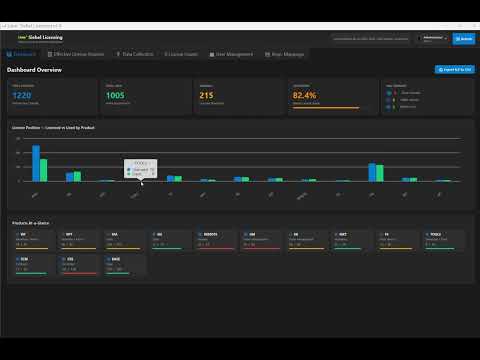
KPI cards, RAG status, utilisation chart — populated from a real Siebel environment.
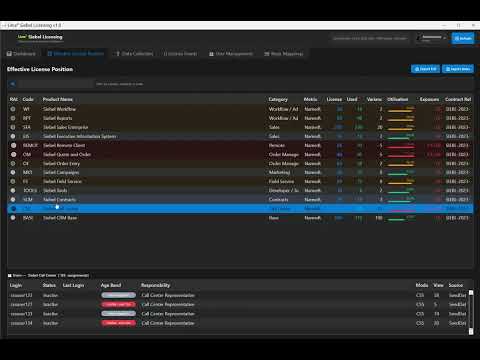
Select a product row, see every user — login name, last access date, responsibility assignment.
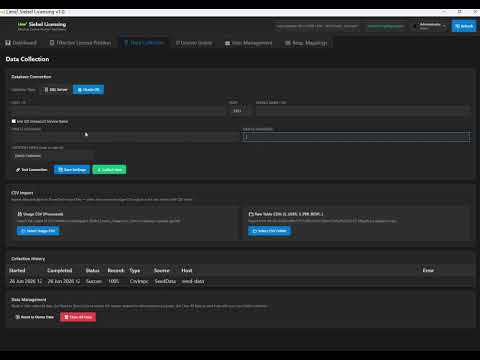
For environments where direct database access isn't available. Run the bundled SQL, import the CSV.
Oracle's bundled SKUs price several modules under one blended per-user metric. That's simpler to buy, but it obscures exactly which modules are covered and at what quantity — and bundle terms vary enough between contracts that assuming yours matches a colleague's is a common mistake.
Siebel's Named User licensing doesn't cover what it runs on. WebLogic, the underlying database, and any Oracle Analytics layered on top are typically licensed by Processor, not by user, with core-factor calculations that have nothing to do with your Siebel head count. A clean Siebel position can still leave an audit finding sitting underneath it.
Contracts predating Oracle's 2006 acquisition carry ambiguity around Named User Plus conversion that is better resolved before Oracle raises it. These conversations go differently when initiated from a position of knowledge.
Under Named User licensing, every account authorised to access Siebel counts regardless of last login. Former employees still active in Siebel are a common finding in every review.
Siebel administrators enable modules during testing. Those modules stay enabled. Oracle checks enabled modules against ordering documents during audit. The gap between the two is a finding independent of how many users are assigned to it.
Siebel perpetual licences carry no automatic trade-in value against CX Cloud subscriptions. Running both in parallel during migration creates a dual-licensing cost that is consistently underestimated. The negotiation goes better with a documented Siebel position in hand.
Oracle has demonstrated large-scale Siebel deployments on OCI with Kubernetes. For organisations considering OCI migration, BYOL processor metric calculations under Oracle's cloud policy need careful assessment before any commercial discussion.
Customers and partners accessing Siebel via portals require external metrics — Registered User, not Application User. The distinction matters and is frequently overlooked in estates that have grown portal usage organically over the years.
Questions about the tool, your Siebel estate or responsibility mapping? Email us and the response comes directly from the development team, not a sales queue.
Email info@lime-software.comLime Software Ltd is an Oracle licensing consultancy based in Norwich, UK. Over 100 client engagements across Siebel, EBS, Database, Java and Middleware over more than 20 years — independent, with no Oracle reseller relationship and no audit referrals.
The Siebel tool was built after working through real customer data and noticing that the skills and tooling to support Siebel license reviews had largely disappeared from the market. Twenty-plus reviews over ten years informed what went into it.